LIVERPOOL MUSIC HERITAGE TRAIL – The Vinyl Frontier – NEMS and Probe
Whitechapel
“It’s impossible to exaggerate how much the city of Liverpool was a seaport.”
Tony Lane, historian,1987
Walk around the neighbourhood today and other than the impressive statue of Brian Epstein, there is little to remind you that it was once Liverpool’s equivalent to Denmark Street in London. From the late 1950s through to the late 1990s, this district was a vibrant, thriving destination for music lovers and musicians.
Originally called Frog Lane, it was known as Whitechapel by 1781, taking its name from a nearby chapel. The original ‘pool’ inlet meandered right up to where Whitechapel is now, and the street was built over it.
The relentless growth of the port saw the Whitechapel area transform. By the early 20th century its impressive brick structures filled the skyline. With names like Chicago, Kansas and Montreal Buildings – part office accommodation and storage facilities – there can be little doubt where the influences of this city lay.
Whitechapel gained a very early reputation as a place of ill repute. Music could hardly fail.
Music
“Curly Music owned the whole building – it used to be a warehouse and then a print works. They rented us the first floor for 25 quid a week and we recorded our first two albums there.” Andy McCluskey, OMD, 2023
Established in 1828, Rushworth & Dreaper music store was a Liverpool institution and world leader too. It moved from Islington to Whitechapel in 1960. Jam packed with five floors of instruments, sheet music and records, it became known as the largest music house in Europe. With Hessy’s Music Centre and Curly Music in Stanley Street too, the area was a honeypot for budding musicians.
Elsewhere, rehearsal spaces, management and independent record labels, together with musician hang out spaces like Open Eye gallery, Silly Billies, Kardomah Cafe and Brian’s Diner, gave the neighbourhood a relaxed vibe.
Our music tour brings us to the story of two record stores. These shops didn’t just sell records; they were basecamps for two musical movements.
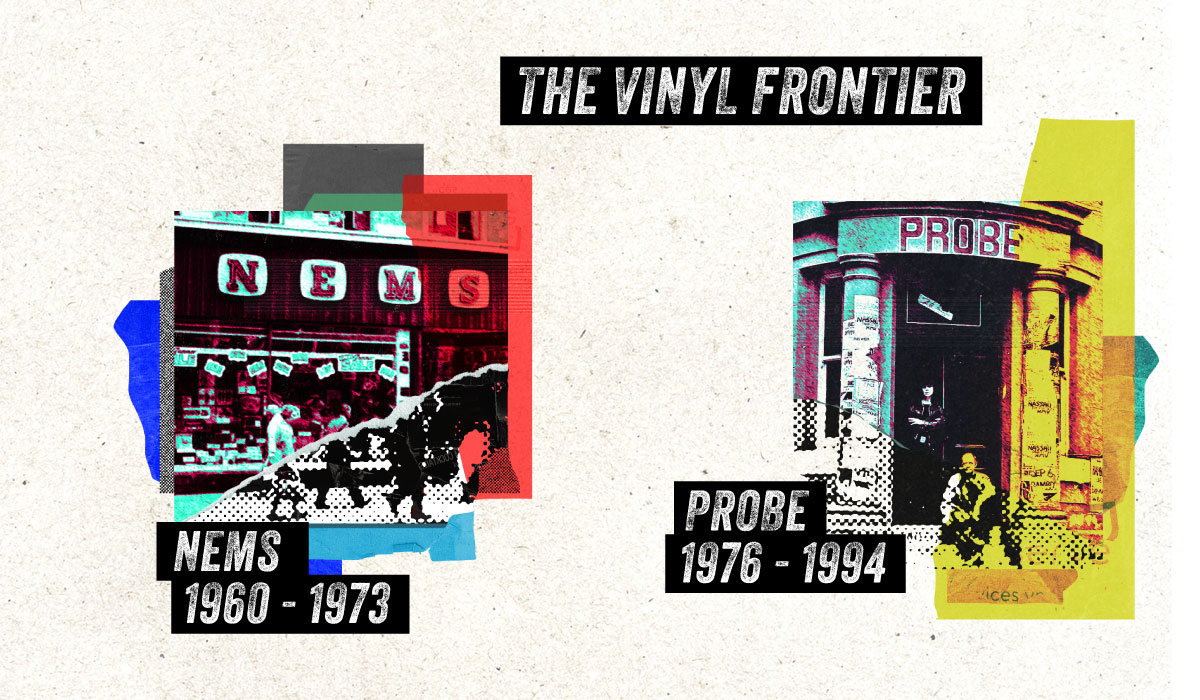
NEMS 1960 – 1973
“Although Liverpool groups recorded over 350 American covers, every one of the originals had been released in the UK. Those originals may not have sold well, but NEMS in Whitechapel stocked every release, as it was Epstein’s belief that no customer should leave dissatisfied.”
Spencer Leigh, broadcaster and author, 2008
NEMS (North End Music Stores) opened its flagship record store at 12-14 Whitechapel in 1960. This purpose built four-storey music emporium, now demolished, lit the touchpaper on a revolution that would reverberate around the world.
Probe 1976 – 1994
“The whole place was loaded with incredible atmosphere – really loaded. People knew their shit and that made it even more scary.”
Julian Cope, musician, 2010
Just off Whitechapel lies Button Street. In the ’70s, despite being right in the heart of the city, it was a rundown, overlooked area. Probe records set up shop here in the prophetically named Enterprise House.
Under the radar yet spitting distance from some of the city’s most prestigious streets, a scene was bubbling under. For some, Probe was its nerve centre.