LIVERPOOL MUSIC HERITAGE TRAIL – Money (that’s what I want) – The State and Liverpool Stadium
The Business District
“Liverpoole is one of the wonders of Britain…What it may grow in time, I know not.”
Daniel Defoe, writer, 1715
Nothing exemplifies the city’s physical metamorphosis from small provincial town to global maritime metropolis than the neighbourhood around Castle Street and Dale Street.
Rising from its elegant waterfront, the buildings ripple out and into the town. Framed by the original seven streets of 1207, the swagger, scale, ambition and sheer opulence of the buildings is monumental. This is Liverpool on all a world stage.
This is where Liverpool did business – insurance companies, banks, shipping companies, commercial offices and traders – all tied to the river. The business of music would go on to define Liverpool in ways unimaginable.
Music
“The streets present a most singular spectacle…hand organs, fiddles, and cymbals plied by strolling musicians mix with the songs of the seamen.”
Herman Melville, writer, 1839
Liverpool was a sailor town. The world passed through the city and entertainment fired the soul. By the late 19th century, little of Melville’s vision remains, washed away on the tide of progress as commerce refashioned the neighbourhood. Ye Hole In The Wall (which lays claim to being the city’s oldest pub,1725), Ma Boyle’s, The Pig And Whistle and Rigby’s on Dale Street, are a few of the popular haunts from that period.
Dale Street is where we spotlight the first of two stories, before heading deep into Old Hall Street. Both are utterly Liverpudlian. One is a love note to style and elegance, the other a homage to pugilism. Music could be a perfect match
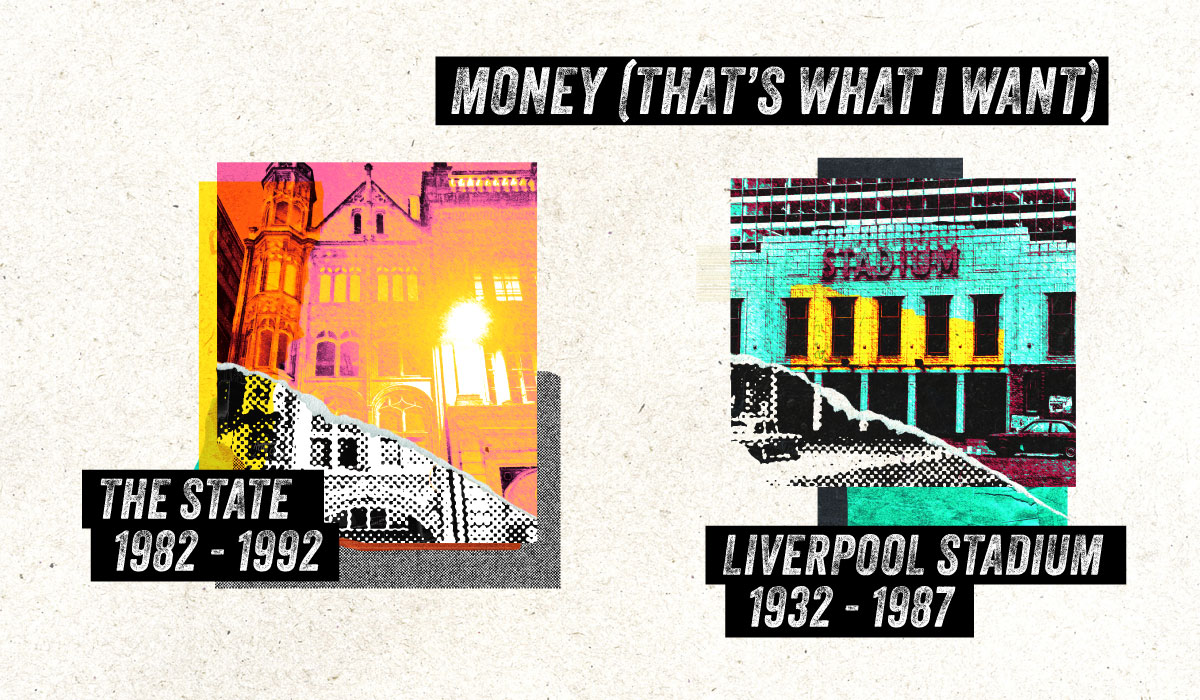
The State 1982 – 1992
“At The State we made the shift from playing student music to the latest American house from Chicago. The club would be packed out on a Monday night.”
Mike Knowler, DJ at The State and Quadrant Park, 2016
Most music club owners take over a rundown building and put on live music nights, despite all the limitations. The State isn’t like most clubs. A beautiful, gothic style grade II listed building, with striking art nouveau style refinements within, it was originally home to a ballroom in the 1920s.
The State went on to hold tea-dances in the 1950s, before the now familiar tale of 1970s neglect. The owners of Kirkland’s, a fashionable bar on Hardman Street, took it over and fitted the club out with only the best, including a state-of-the-art sound system and lasers. The State was a game changer.
Liverpool Stadium 1932 – 1987
“The smell of the place, if only you could bottle it …other venues never matched the Stadium’s. Maybe it was a terrible place acoustically but the atmosphere in there was electric. “
Charlie, Stadium regular, circa 2010
Liverpool’s grand Cotton Exchange building on Old Hall Street, deep in its commercial district, was completed in 1906. A monument to Liverpool’s global influence in the cotton trade, in 1932 it gained an unruly next-door neighbour.
The UK’s first purpose-built boxing venue, Liverpool Stadium, was housed on the site of the old St Paul’s Church. The Stadium’s ornate art-deco facade was pure showbiz, its vast barn interior simple functionality. Demolished in 1985, today it is the site of a modern network of office developments.
Liverpool Stadium earned the unenviable reputation of being the ‘graveyard of champions’. With a visceral, intense and tribal atmosphere, the venue was perfect for music.