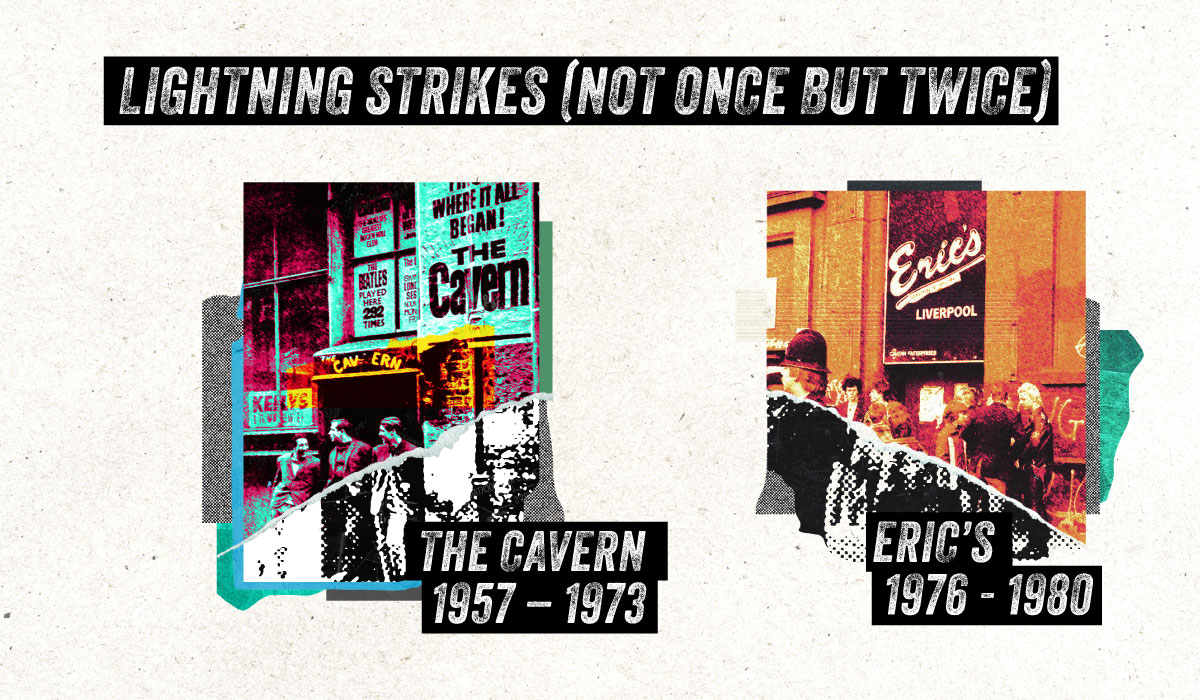
LIVERPOOL MUSIC HERITAGE TRAIL – Lightning Strikes (not once but twice) – The Cavern and Eric’s
Mathew Street
“It is the interstellar ley line. It comes careering in from outer space, hits the world in Iceland, bounces back up, writhing about like a conger eel, then down Mathew Street…”
Bill Drummond, 1981
Originally named Mathew Pluckington Street, after a 1700s merchant and landowner, by the mid nineteenth century this minor alleyway evolved into the beating heart of the city’s fruit and vegetable trade. The Fruit Exchange building on Victoria Street – backing onto Mathew Street – was its business headquarters.
The tight, tall brick-built warehouses were perfect for fruit storage – close to the port, cool, dark and secure. Shifting trading patterns, and the emergence of Queen Square and Edge Lane as fruit and veg markets saw the area collapse.
Framed by its illustrious neighbours – Lord Street, North John Street, Stanley Street and Whitechapel – for years, Mathew Street stood forlorn. Beyond The Grapes and White Star pubs the area was largely forgotten.
It would take a 1950s jazz connoisseur and later, a bunch of mavericks, to propel this dilapidated backwater into the most famous music street in the world. Those old warehouses were quite important, after all.
Music
“(Halligan’s warehouse) was a space where you could talk, dream and think the impossible.”
Larry Sidorczuk, artist, 2015
Creative scenes always lurk out of sight, fermenting away in the shadows. Merseybeat went overground in 1963, bringing the world to the city, to Mathew Street and to its mecca, the Cavern. When the carnival was over, Mathew Street, slipped back into anonymity, a neglected relic of the past once more.
In 1974, Bootle born poet, artist and surrealist Peter Halligan took over the large corner warehouse at No 14 Mathew Street. A madcap space for dreamers and outsiders, at various times it was home to The School of Language, Music, Dream and Pun, Aunt Twackies, Ken Campbell’s Science Fiction Theatre, a cafe and a rehearsal space. By 1976, it was a cornerstone of the city’s fertile counterculture.
Music has always been critical to the city’s identity. Our tour arrives at two cellar dwellings that, yards apart but in vastly different ways, would change the face of music and Liverpool.
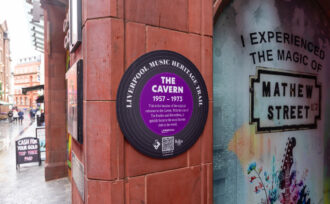
The Cavern 1957 – 1973
“You could never deny you’d been to the Cavern because of the smell on your clothes. It was unique, a mixture of all different horrible things. No other club had that.”
Freda Kelly, Caven regular and Beatles secretary, 2008
6a Mathew Street, once a warehouse for storing fruit, also acted as shelter during World War Two. Smelly and dank it may have been, but in January 1957, Alan Sytner, a jazz music aficionado had a dream to bring the Left Bank to Liverpool and opened his own basement club there. He called it The Cavern, after Le Caveau in Paris.
Eric’s 1976 – 1980
“Eric’s opening was the most incredible thing in the world to us. It totally changed our lives, you know. It gave us a home from the first day we walked in there.”
Jayne Casey, musician, 2008
In the mid-1970s, Roy Adams, a prominent nightclub entrepreneur, owned several clubs in the Mathew Street area, including Gatsby’s in the former Fruit Exchange building on Victoria Street.
Local music figures, Roger Eagle and Ken Testi used the ground floor of Gatsby’s – formerly known as The Revolution – to put on their own live music nights. They called it Eric’s – its name an antidote to glamour palace clubs – with an entrance via the fire escape door at the back on Mathew Street. Soon after, with Pete Fulwell joining them, they made the basement the club’s permanent home.
Eric’s was the catalyst for Liverpool’s punk and post punk scene explosion.