
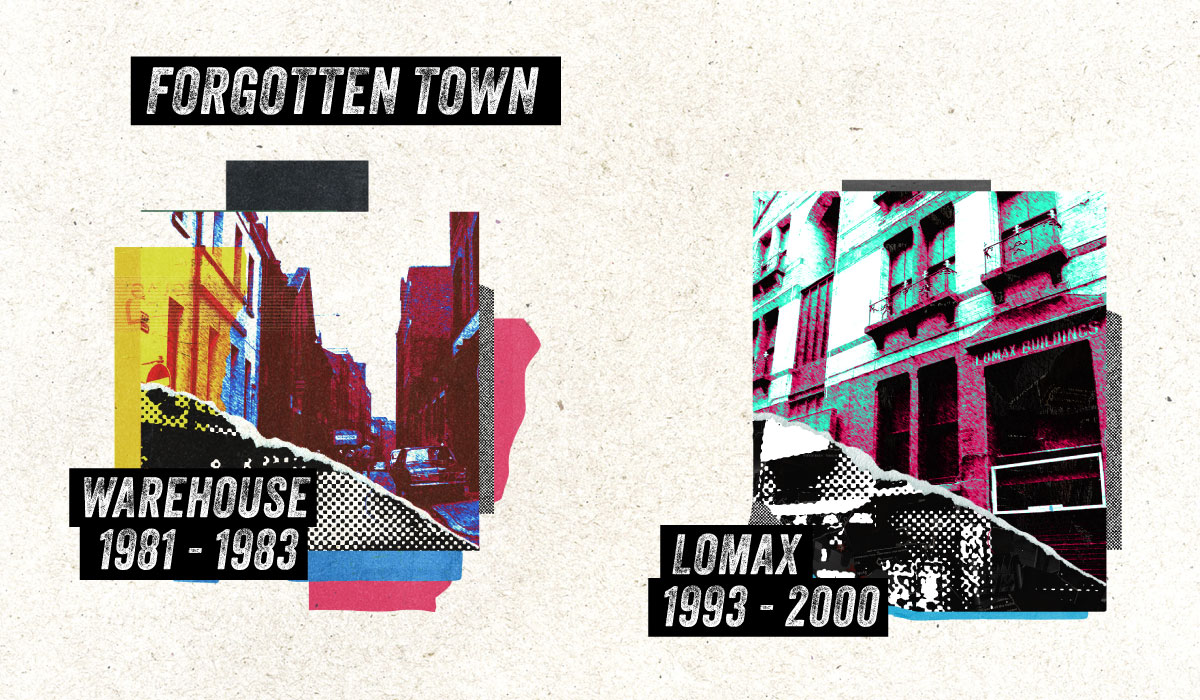
LIVERPOOL MUSIC HERITAGE TRAIL – Forgotten Town – Warehouse and The Lomax
Abandoned Warehouses
“They should put a fence around Liverpool and charge admission, for unfortunately it has become a showcase for all that has gone wrong in Britain’s cities.”
Daily Mirror, 1982
Liverpool’s last highwater mark as a global powerhouse was the 1930s. Decades of remorseless decline, followed by abject collapse in the 1970s and 80s, left the city on skid row. The population shrank by nearly 30% to around half a million people, and with unemployment running at 27%, almost 15% of Liverpool was vacant or derelict.
The vast government owned bonded warehouses that lined the waterfront lay neglected and redundant. They stood as mausoleums to the city’s lost status as a world port.
The city centre appeared to fall in on itself and shrink too, with pockets of semi-abandoned backstreets, and old maritime industry areas sitting neglected alongside everyday life.
Music
“Liverpool’s a hard town; you have to keep your wits to survive… you have to build up your character until you’re a star.”
Pete Wylie, rock star, 1982
In the back alleyways between the city’s grandest streets, private warehouses lay obsolete. Deep in the heart of the city, cheap, available and out of sight of the mainstream, some transformed themselves into grassroots music venues.
The warehouses of Mathew Street were reimagined through music in the 1960s and ‘70s. With the city on its knees in the ’80s and ’90s, music offered hope once again.
Our trail takes us two tall brick-built warehouses that shaped music scenes at equally vital times for the city.
Warehouse 1981 – 1983
“The best gigs you see are those that give you a feeling similar to when you drive over a bridge too fast, that jump in your chest…nights like these seemed to be readily available at The Warehouse.”
Banjo, Warehouse regular, 2018
With bands booked by local music promotor Dave C, The Warehouse opened at 13-15 Fleet Street, just off Hanover Street.
Today the area is rebranded as the Ropewalks District. In the early 1980s, Fleet Street was just a rundown backstreet. Another victim of the latest economic nadir for the city. Music offered salvation. The Warehouse’s Klub Fiasco nights – live music, five or six nights a week – were a godsend for some. For others, life changing.
Lomax 1993 – 2000
“We wanted the Lomax to have the same kind of feeling as Eric’s …at the time, you don’t think, ‘this is special’ – that only happens when it’s all over and you look back.”
Mike Hindley, co-owner, The Lomax, 2008
Tucked away but in the heart of Liverpool’s commercial district, lies Cumberland Street. This narrow street housed steep brick warehouses, the Poste House pub and even a Bridewell jail. Today it is an integral part of the city’s LGBTQ neighbourhood with Masquerade Bar and the Poste House, both popular destinations.
In 1993, entrepreneur music fan Mike Hindley opened The Lomax. Sitting across three floors of the Lomax Building at 34 Cumberland Street, it became a much loved and influential scene shaper.