BEYOND THE SONG: THE NARRATIVE AT SHAKESPEARE NORTH PLAYHOUSE
There is something different about hearing a song when you know where it came from.
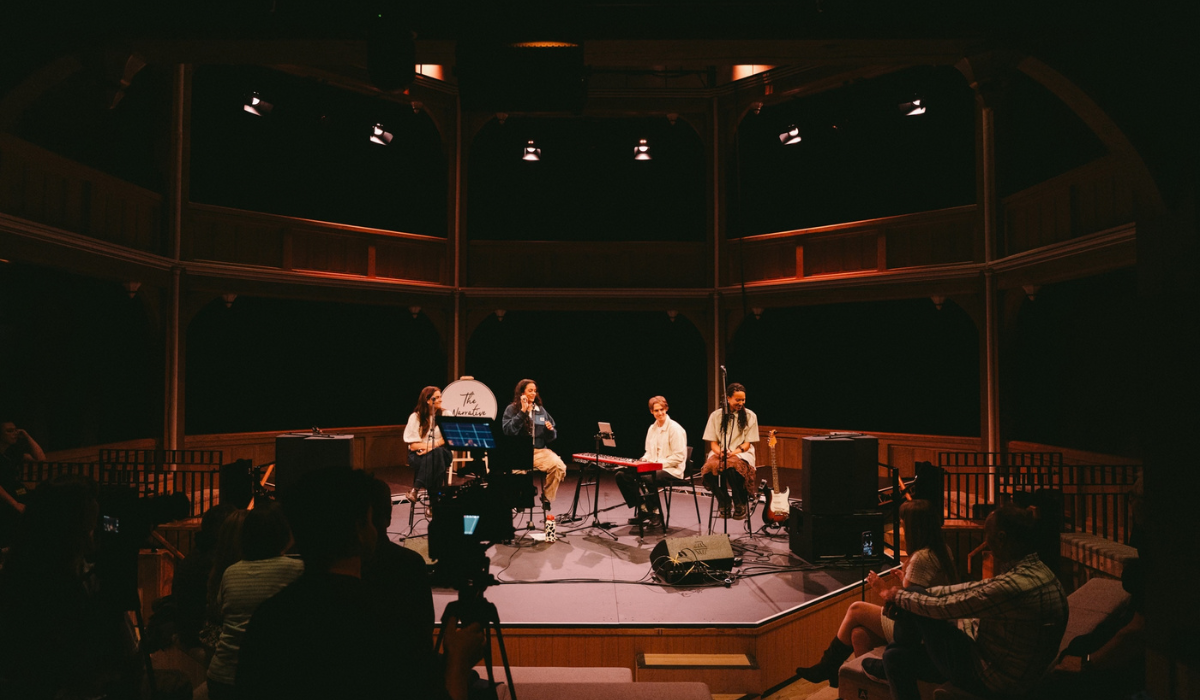
Inside an intimate, wood-panelled room at Shakespeare North Playhouse, four songwriters sit together with little more than their instruments and the stories behind their music. While one performs, the others listen. Eyes close, heads bop along and, for an evening, the usual distance between artist and audience seems to disappear.
This is The Narrative, a songwriters’ round founded by Rheana Breckon in 2023, built around something deceptively simple: giving songwriters a space to share their work and talk about how it came to exist.
The idea grew from Rheana wanting to attend something that she simply couldn’t find. As a songwriter who works behind the scenes rather than as a performing artist herself, she wanted somewhere to meet other writers, make connections and potentially find new collaborators. She also wanted to hear the stories behind their songs. When that space didn’t exist, she created it.
Tonight, that idea finds a fitting home at Shakespeare North Playhouse.
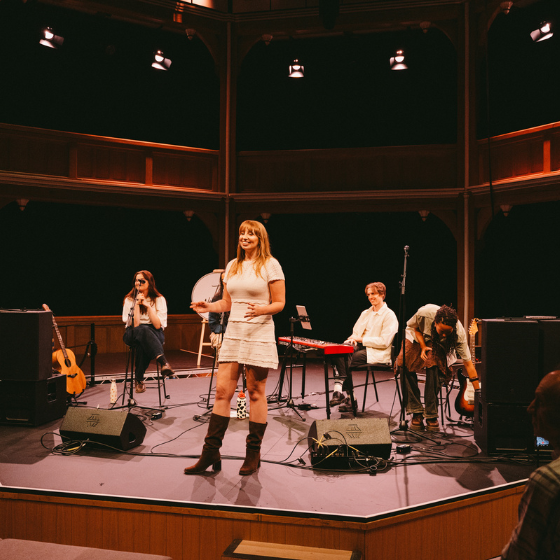
Immi Dash begins with Fix It, joined by James Breckon on piano. With the arrangement stripped back to just piano and voice, Dash’s soulful vocal carries through the wooden room, while the other artists look almost enchanted as they listen, eyes closed and heads gently moving along.
The story behind the song reveals something particularly interesting about songwriting: its meaning can continue to evolve long after a song has been written. Dash explains that Fix It came from a difficult period in her life and was initially rooted in frustration at being unable to change what had happened. With time, however, she has found a sense of acceptance in that same idea. Singing it now represents growth rather than trying to find a solution.
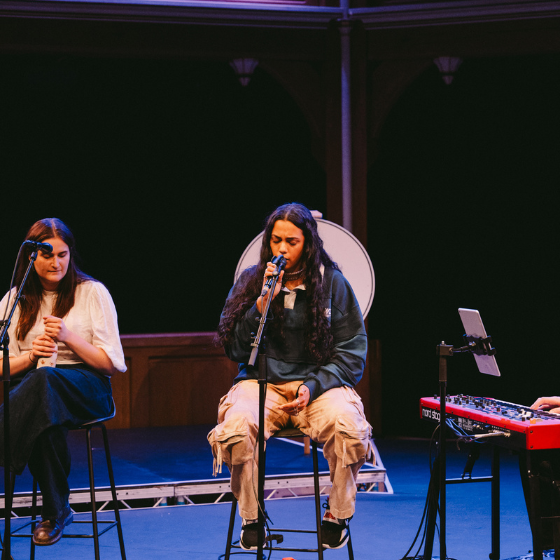
The song might remain the same, but the person singing it doesn’t.
Later, Moonflower offers another glimpse behind the curtain. Dash describes how the songs from the same EP began with just piano and vocal before she took them to a band, bringing references for how she imagined different elements could sound. The musicians brought their own ideas to the arrangements before recording together live in the studio.
Her inspiration can arrive from less conventional places too. Dash explains that she often searches Pinterest while writing, scrolling through images around an idea until something catches her attention. For Moonflower, discovering a white flower that opens at night gave her the starting point for the song.
There is a humility to Dash throughout. Even the practicalities of performing become part of the conversation, including some memorable advice from a former singing teacher: never be upstaged by a mic stand.
That informality is part of what makes The Narrative work. These aren’t polished interviews taking place after a performance. The conversation, tuning, jokes, mistakes and explanations are part of the evening itself.
Child of Sowo stands with her guitar because that’s how she always practises. Just her and the instrument, the intimacy of her voice becomes even more striking. Intricate, jazz-inflected guitar melodies weave beneath an ethereal vocal, each seemingly following its own path without ever losing the other. There are shades of Lianne La Havas in the relationship between voice and guitar, but Child of Sowo’s intensely personal writing quickly establishes a world of its own.
Her songs take us directly into the workings of her inner mind.
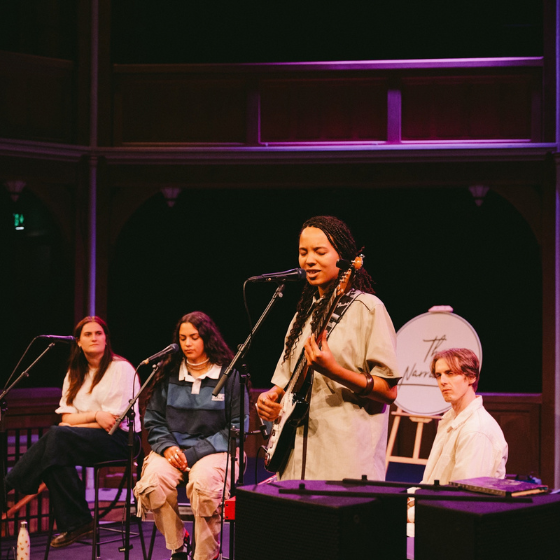
One reflects on a previous relationship between two people who were well-intentioned but ultimately incompatible, and the cycle created when one person struggles to voice how they feel while the other expresses everything outwardly. The_Narrative_Transcripts.pdf Another confronts an inferiority complex, drawing partly from growing up alongside a twin brother to whom music seemed to come naturally, despite it not being his passion.
Another turns towards grief and the idea of karma. Using the metaphor of passing on a lucky penny, Child of Sowo explores her belief that life’s good and bad fortunes eventually find some kind of balance, before questioning whether that logic can really account for loss. Some experiences simply cannot be balanced out by something good arriving later. Writing the song became a way of exploring that contradiction and processing her own grief.
It is precisely the kind of context that changes how a song lands. The technical intricacy of her playing is impressive on its own, but here we’re also invited to understand what all of those chords and melodies are carrying.
With Grace, the conversation turns towards communication itself.
Her song The Dream of a Common Language takes its name from an Adrienne Rich poetry anthology she discovered while browsing a charity shop. The collection led her to think about words and their limitations, particularly within relationships: the idea that language can never quite communicate exactly what another person means or feels.
For a songwriter, it’s an intriguing problem.
Grace’s answer is that other forms of expression can occupy the spaces words leave behind. The instrumental section at the end of the song represents that conclusion: music, colour, gesture, body language and symbolism can communicate where language struggles to.
In a room dedicated to the craft of songwriting, it feels like an appropriate thought to leave hanging in the air.
Liverpool has no shortage of places to hear music. What The Narrative offers is something slightly different: a place to understand how that music is made, what inspires it and who the people are behind it.
There are no barriers here between the finished song and the experiences that created it. A difficult period becomes Fix It. An incompatible relationship becomes a lyric. A charity-shop book sparks a meditation on language. An image found while scrolling online becomes Moonflower.
Somewhere between the performances, guitar tunings, laughter and stories, the artists aren’t only sharing their songs with an audience. They’re sharing them with each other.
For a project that began because Rheana Breckon wanted somewhere for songwriters to meet, listen and connect, perhaps that’s the most important part.